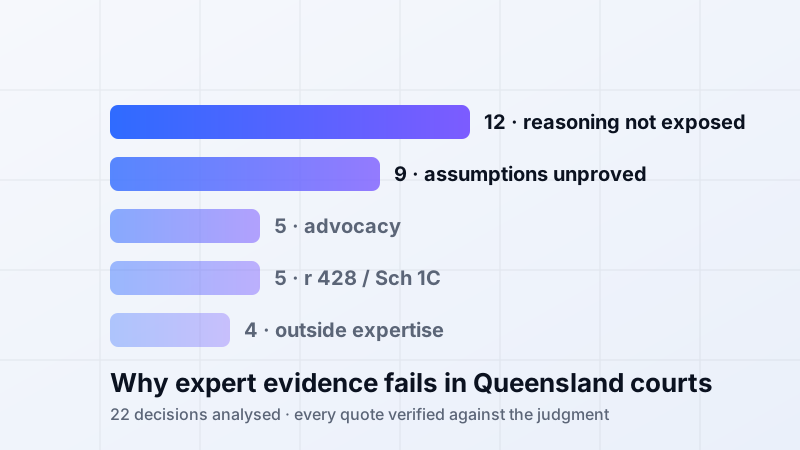
We analysed 22 Queensland decisions, from 2005 to 2025, across the Supreme Court, Court of Appeal and QCAT, in which expert evidence was contested, criticised or rejected. Every quotation below was verified word for word against the published judgment text.
The pattern is not what most practitioners expect. The failures that kill expert evidence in Queensland are rarely about the expert's credentials, and only sometimes about bias. In two thirds of the decisions we analysed, the evidence failed on its basis: unexposed reasoning, or assumptions that were never proved.
What actually kills expert evidence
Categories overlap; most failed reports fail in more than one way.
| Failure mode | Decisions |
|---|---|
| Reasoning not exposed (the Makita problem) | 12 |
| Assumptions or factual basis not proved | 9 |
| Independence lost to advocacy | 5 |
| UCPR non-compliance (r 428 and Schedule 1C) | 5 |
| Opinion outside the expert's field | 4 |
| Flawed methodology | 2 |
Counts from the 22 analysed decisions; a single decision can carry more than one failure mode.
The report that shows no working
The single most common killer is the opinion that states a conclusion without exposing the path to it. The courts have a name for this: the bare ipse dixit.
In a 2025 medical negligence trial, the plaintiff's expert delivered a breach opinion the court described as "is in the nature of a bare ipse dixit" and "completely unreasoned" (Filmalter v Swenson [2025] QSC 32 at [199]). The opposing expert won for the mirror-image reason: his opinions were "logical and reasoned and based upon the correct assumptions".
The principle is old and constantly restated. Refusing leave for a report that failed the statement of reasoning rule, the Supreme Court quoted Sir Owen Dixon: "courts cannot be expected to act upon opinions the basis of which is unexplained" (Springfield City Group v Pipe Networks [2020] QSC 395).
The assumptions nobody proved
An expert may build on assumptions, but someone has to prove them. The Supreme Court said it plainly in a 2024 construction trial: "An expert is entitled to provide their expert opinion on the basis of factual assumptions but their evidence is virtually worthless unless the assumptions are proven by admissible evidence" (Hestbay v One Sector [2024] QSC 180 at [753]). The engineer's key opinions had no evidential foundation and the claim was dismissed. Notably, the unproven assumptions had been supplied to the expert in an email from the instructing solicitors.
The Court of Appeal applied the same rule to an engineer whose scenario did not match the evidence: the "disconnect between the factual hypothesis underpinning that opinion, and the facts as his Honour found them to be" was fatal (Bilson v Vatsonic [2024] QCA 171 at [51]). And in Beaven v Wagner [2017] QCA 246 the court reminded the profession that an expert's recitation of a client's story is not proof of it, adding: "There is nothing new in any of this. It should be well understood by all counsel."
The counter-example proves the rule. In R v Naidu [2008] QCA 130 a psychiatrist's opinion survived challenge, despite imperfect proof, because "the essential integers underlying his opinions were clearly identified in his evidence". Transparency about the basis is what saves an opinion under fire.
The expert who became an advocate
Queensland decision-makers are blunt when an expert crosses the line. A Court of Appeal reference rejected a scientist who showed "a level of personal commitment to Mr Butler's cause which is not consistent with the detachment and independence which is to be expected of an expert witness" (R v Butler [2009] QCA 111 at [127]). A QCAT quantity surveyor who admitted reducing a claim by nearly $40,000 on his client's instruction was held to give "every appearance of acting, not as independent expert, but as advocate" (Monsour v C & R Darvill [2022] QCAT 302 at [61]). In another building dispute the Tribunal found both parties' experts were advocates in the same paragraph (Imperial Homes v Boys [2020] QCAT 299 at [12]).
Independence problems can start with the lawyers. In Landel v Insurance Australia [2021] QSC 247, the court wrote: "I am critical of the defendant's lawyers for meeting with both experts together" before their reports were written.
The rules failures
Rule 428 of the UCPR and the Schedule 1C Code of Conduct are not decoration. A valuation report supporting a $50 million claim failed in part for non-compliance with r 428(c) (Dupois v Queensland Television [2015] QCA 160). In Ferrari Estate v Cooktown Earthmoving [2016] QCA 266, twelve years without a conforming report helped end the claim entirely.
The Supreme Court has explained why the formalities matter: the r 428(3) confirmations exist so that experts are "reminded directly and on every occasion that their primary duty is to provide a fair and honest report of their genuinely-held opinions to the court (uninfluenced by the fact that one party is paying their fees)" (Murphy Operator v Gladstone Ports (No 7) [2021] QSC 18 at [20]).
One boundary worth knowing: joint expert reports are governed by r 429B and the order directing them, not by r 428's content list (Miles v Editshare [2020] QCA 78).
What failure costs
These are not academic points. Across the 22 decisions: a $50 million claim summarily ended; a construction claim dismissed after the core expert opinions received no weight; a proceeding dismissed for want of prosecution with the non-conforming report a listed reason; and, in Sutton v Hunter [2022] QCA 208, the successful party still lost every dollar spent on its excluded report, because the costs order carved out the entirety of costs related to it.
What the surviving experts did
Across the same decisions, the experts who won did the same few things: identified every assumption and its source, showed the working, stayed inside their field, made concessions when warranted, and wrote for the court rather than the client. The Tribunal's praise for the preferred quantity surveyor in Monsour is a template: his reports "set out and explain in detail the information he was provided and its source" with calculations "set out in significant detail".
The practitioner checklist
- Brief the question, not the conclusion: assume the letter of instruction will be read by the court
- List every assumption, flag which are instructed, and plan the admissible proof for each one
- Demand the reasoning chain for every opinion: a conclusion without working is a target
- Keep each expert inside their demonstrated field; use two experts rather than one stretched one
- Check r 428 and Schedule 1C compliance before service, not at objection
- Protect independence in the engagement itself: written instructions, separate conferences, no dual roles
Method
Decisions were identified through searches of AustLII, the Queensland Judgments database and the Supreme Court Library of Queensland across seven search themes, then analysed in full from the published judgment text. Every quotation was string-matched verbatim against that text before publication. This is a first tranche, weighted to civil litigation, and will be extended as new decisions are published.
This article is general information about published decisions, not legal advice. Outcomes always depend on the whole of the evidence in a given case.